Watch where your hand travels
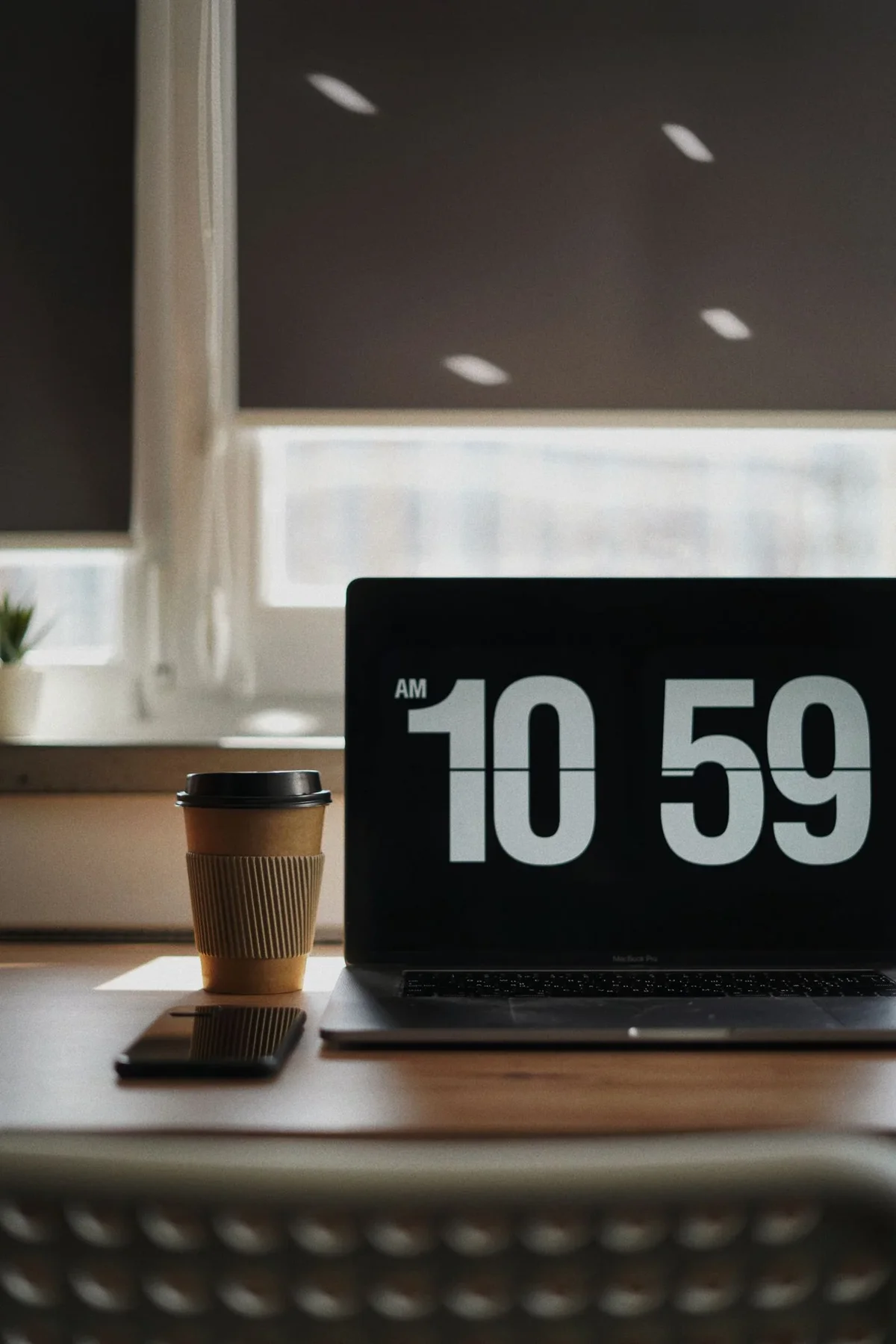
Place an empty mug on the desk and go through an ordinary task. Reach for the mouse, pick up your phone and pull a notebook towards you. Notice where your forearm passes. A drink often ends up wherever there happened to be a small gap, but that is not necessarily a position you can reach consistently without catching something else.
Look for a stable surface outside your main working movements. A low, accessible surface beside the desk may be more useful than a space between the laptop and mouse, provided it does not obstruct a walking route. There is no universally correct side: handedness, desk shape and the equipment in use all affect what makes sense.
Distance matters more than a nice coaster
A coaster can protect a surface from a few drips. It cannot prevent a mug from tipping or contain a larger spill. Leave as much practical separation as you can between a drink and the laptop, keyboard, connectors or power strip. A cup positioned above equipment, such as on a monitor riser with a computer beneath it, creates an especially unhelpful arrangement.
Look below the tabletop as well. A drink near the edge could spill onto a power adapter, extension strip or cables on the floor. Position power connections according to their manufacturers’ guidance and keep them away from likely drip paths. A clear desktop does not, by itself, tell you whether the area underneath has been arranged sensibly.
A lid only helps when it suits the routine
A container with a properly fitting lid may be useful at a changing workspace. Check that it is assembled correctly and intended for hot drinks before use. Claims about leak resistance have conditions, and an open drinking aperture is still an opening. Do not rest even a closed cup on equipment or assume a bag will protect everything inside from a spill.
Choose a size that sits securely on the intended surface. A tall, narrow container squeezed between cables is easier to catch than a mug in a deliberately clear area. Fill and wash it away from the desk. This keeps the kettle, wet lids and sticky spoons away from equipment as well, instead of treating the cup as the only possible source of liquid.
Make shared arrangements visible
When several people use a desk, an obvious place for drinks is more helpful than an unspoken personal habit. Keep that area clear and agree where mugs go afterwards. Children, pets and visitors can change how people move around a room; an edge that was undisturbed yesterday may become a poor choice today.
Avoid carrying a drink over an open keyboard to reach the other side of the desk. Put it on a suitable surface briefly and clear the route first. Small routines are often more dependable than another accessory. If you frequently move between rooms, consider separating the drink break from the task of carrying the computer and its cables.
Do not experiment after a spill
If liquid reaches a device, put personal safety first. Do not touch wet mains connections. Use only safely accessible ways to disconnect power and follow the manufacturer’s instructions. Do not switch the equipment on simply to see whether it still works, heat it or rely on household remedies. If you are unsure, or mains electricity is involved, seek appropriate professional help rather than attempting an improvised repair.
Give drinks a stable home outside normal reaching movements and away from equipment and power connections.